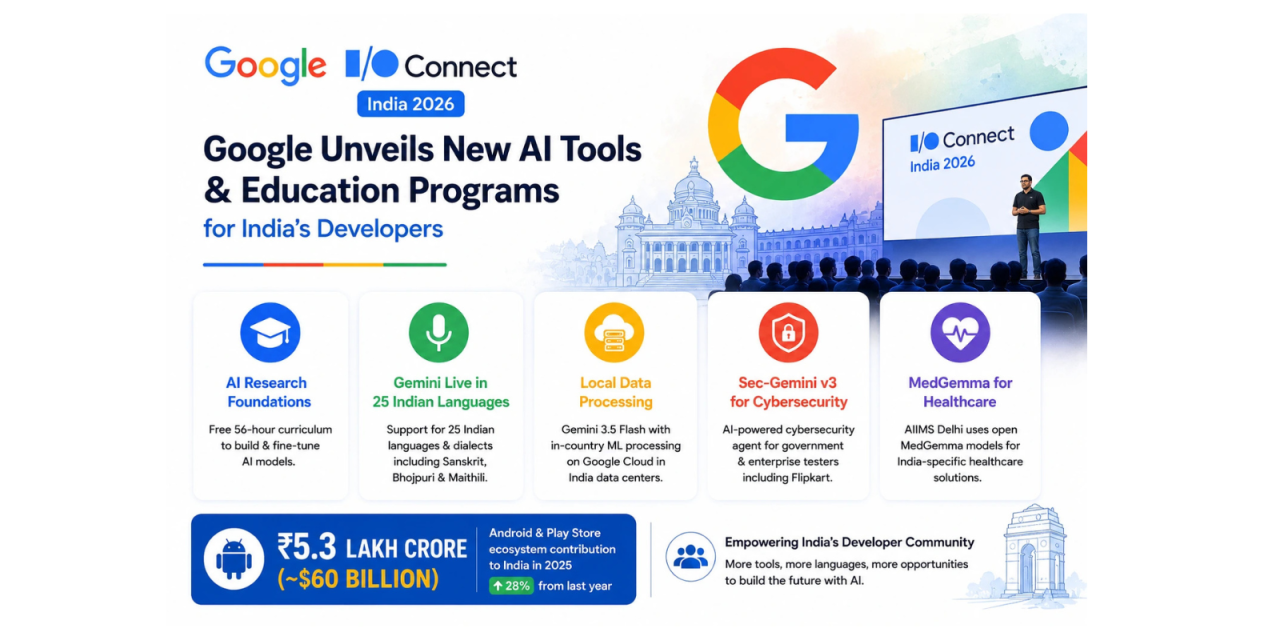
Google used its I/O Connect India 2026 summit in Bengaluru to lay out a genuinely broad set of AI initiatives aimed at Indian developers, startups, enterprises, and students, spanning free education programs, healthcare partnerships, cybersecurity tools, and expanded local cloud infrastructure. The announcements arrived alongside a striking economic figure, Google said its Play Store and Android ecosystem generated an estimated ₹5.3 lakh crore, roughly $60 billion, for the Indian economy in 2025, a 28 percent jump from the previous year. For a site tracking India’s app and developer ecosystem closely, this summit is worth unpacking in detail, since several of these announcements will directly shape what Indian developers can build over the coming year.
Free AI Research Foundations Curriculum
Google DeepMind introduced a free 56-hour curriculum called AI Research Foundations, designed to teach learners how to build and fine-tune large language models. The program will be delivered through Google Skills and expanded in partnership with NASSCOM, the Indian Institute of Science Bengaluru, and AVPN, giving Indian students and early-career developers a genuinely structured, no-cost path into serious AI model development.
Gemini Live Now Supports 25 Indian Languages
Gemini Live’s language support now covers 25 Indian languages and dialects, including Sanskrit, Bhojpuri, and Maithili, a meaningful expansion for developers building voice-first products aimed at users outside India’s traditionally English-and-Hindi-dominant tech audience.
Local Data Processing for Enterprise Gemini
Gemini 3.5 Flash will now be available with in-country machine learning processing commitments for Indian businesses, and enterprises and public sector organizations can run Gemini on Google Distributed Cloud within Indian data centers, addressing data localization requirements that have historically been a real barrier for regulated industries adopting cloud AI tools.
Sec-Gemini v3 for Cybersecurity
Google announced Sec-Gemini v3, an AI-powered cybersecurity agent, will be made available to select government and enterprise testers, including Flipkart, extending Google’s AI security tooling into genuinely high-stakes Indian enterprise and public-sector environments.
MedGemma Models for India-Specific Healthcare
Researchers at AIIMS Delhi are using Google’s open MedGemma models to develop India-specific AI tools for leprosy and sexual and reproductive health, with the resulting models set to be made available to the country’s broader developer ecosystem once ready.
Why This Matters for India’s App Developer Community
Beyond the individual product announcements, the summit signals Google’s continued bet that India’s developer ecosystem is central to its broader AI strategy, not a secondary market receiving trimmed-down versions of tools built primarily for the US or Europe. Preeti Lobana, Google India’s Country Manager, said India’s builders are already deploying AI faster than almost anywhere else, framing the announcements around giving developers the underlying infrastructure and safeguards needed to build securely as AI shifts from answering questions to executing tasks directly. For Indian app developers specifically, the combination of free, structured AI education, expanded regional language support, and local data infrastructure genuinely lowers several practical barriers that have made building AI-powered, India-specific products harder than it needed to be until now.
The scale of these announcements, spanning education, healthcare, cybersecurity, and enterprise infrastructure, reflects how central India has become to Google’s broader AI ambitions, and the free AI Research Foundations curriculum in particular is worth serious attention for any Indian developer or student looking to build genuine AI model skills without an expensive course. Expect more region-specific tooling to follow this pattern in the coming months, as the $60 billion figure Google shared for the Android app economy alone makes clear how much is riding on India’s continued digital growth.