QA testing remains one of the more accessible entry points into India’s tech industry, requiring less upfront coding depth than a full developer role while still offering a genuine path into software careers with room to specialize and grow over time. As app development in India continues expanding across fintech, e-commerce, and edtech, the demand for testers who can catch bugs before they reach real users has grown right alongside it. Here’s a practical look at what it actually takes to break into QA testing and build a genuine career from there.
Understanding What QA Testers Actually Do
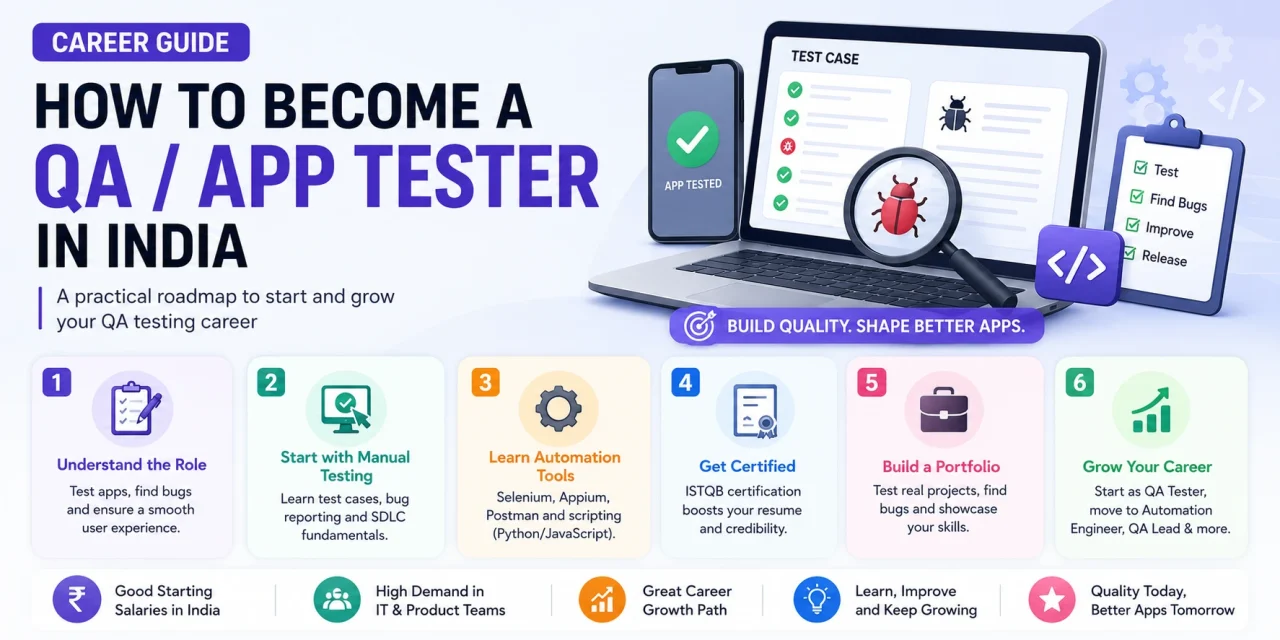
QA testers verify that an app behaves correctly across different devices, operating systems, and user scenarios, catching bugs, crashes, and usability issues before they reach real users. The role spans both manual testing, where testers methodically work through test cases by hand, and automated testing, where testers write scripts that run repeatable checks automatically.
Starting with Manual Testing Fundamentals
Most testers begin with manual testing, learning to write clear test cases, report bugs with enough detail for developers to reproduce them, and understand basic software development lifecycles. This foundation matters even for testers who eventually move into automation, since understanding what to test well is a separate skill from how to automate it.
Learning Automation Tools
Tools like Selenium, Appium, and Postman for API testing have become genuinely valuable skills that significantly boost earning potential compared to manual-only testing roles. Learning basic scripting in Python or JavaScript alongside these tools opens considerably more job opportunities than manual testing skills alone.
Certifications Worth Considering
ISTQB certification remains widely recognized by Indian employers as a genuine signal of foundational testing knowledge, and while not always mandatory, it can meaningfully strengthen a resume for candidates without prior professional testing experience.
Building a Portfolio Without Prior Experience
Testing personal projects, open-source apps, or even deliberately finding and reporting bugs in popular apps through official bug bounty or beta testing programs can genuinely demonstrate real skills to employers when formal work experience is still missing from a resume.
Salary Expectations and Career Growth
Entry-level manual testing roles in India typically start modestly compared to development roles, but the gap narrows considerably once a tester adds automation skills to their toolkit, since automation testers are consistently in higher demand and shorter supply than manual-only candidates. Career progression from QA tester commonly leads toward roles like QA lead, automation engineer, or even a full transition into development for testers who build strong coding skills along the way. Companies increasingly value testers who understand the product deeply enough to think like a user, not just execute predefined test cases, which is a skill that develops with genuine experience and curiosity rather than a certification alone. Building that product intuition early, even informally by using and critiquing apps you didn’t build, pays off noticeably once you’re evaluating real software professionally.
QA testing offers a genuinely realistic entry point into India’s tech industry for people without a traditional computer science background, provided they’re willing to build both the manual testing fundamentals and, eventually, some automation scripting skills. Start by learning to write clear, thorough test cases and reporting bugs effectively, then layer in a tool like Selenium or Appium once those fundamentals feel solid, that progression tends to open considerably more doors than jumping straight to automation without the underlying testing discipline first.