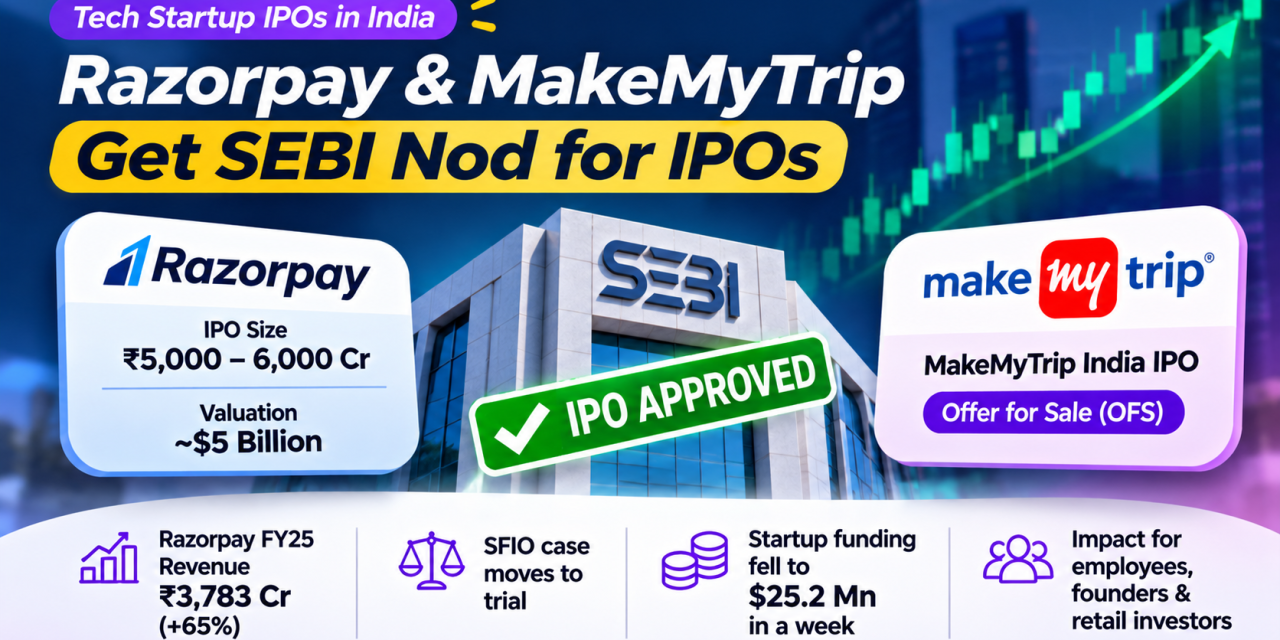
Two of India’s best-known internet brands are now cleared to go public. SEBI issued final observations on Razorpay’s IPO papers on 3 November and on MakeMyTrip’s Indian subsidiary on 6 November, adding two big names to the queue of tech startup IPOs in India. The approvals landed in a week when private funding almost dried up, which makes the public market look like the more reliable route to capital right now.
Razorpay IPO: What SEBI Has Cleared
Razorpay filed its draft papers through SEBI’s confidential pre-filing route in June 2026. The company has not disclosed the issue size, but people familiar with the plan put it at ₹5,000–6,000 crore, at a valuation of about $5 billion. Business Today reports that the original plan was to raise $700 million at roughly $7 billion, so the target has come down.
Founded in 2014 by Harshil Mathur and Shashank Kumar, the Bengaluru company offers payments, banking, payouts, payroll and lending. It completed its reverse flip to India in May 2025. Key numbers:
- FY25 revenue: ₹3,783 crore, up 65% from ₹2,296 crore
- FY25 net loss: ₹1,209 crore, linked largely to one-time ESOP and tax costs from the reverse flip
- Investors include Peak XV Partners, GIC, Tiger Global, Ribbit Capital and TCV
- Listing is expected as early as the first quarter of calendar 2027
Source: CNBC TV18, Business Today
The SFIO Case Running Alongside the IPO
The approval comes with a legal overhang. On 4 November, the Karnataka High Court dismissed a petition by Mathur and Kumar to quash criminal proceedings brought by the Serious Fraud Investigation Office. The complaint alleges that about ₹320 crore linked to a digital lending operation passed through Razorpay’s payment aggregation platform, and that merchant checks were inadequate.
The court said these were factual questions for a trial and did not rule on the allegations. Razorpay maintains that neither the company nor its directors had any link to the entities involved. Expect the offer document to address this risk in detail.
Source: CIOL
MakeMyTrip India: A Listing With No Fresh Capital
MakeMyTrip (India) Ltd, the Gurugram-based arm of the Nasdaq-listed travel company, also filed confidentially, in July. Its IPO is purely an offer for sale by the parent and ibibo Group Holdings, so the Indian company raises no new money. A media report puts the size above $1 billion.
The parent will stay in control and keep consolidating the Indian unit. It says a local listing should raise brand visibility and help it hire and reward tech talent, while sale proceeds may fund acquisitions and buybacks. The timing helps: MakeMyTrip swung to a $1.8 million net profit in the September quarter, with gross bookings up 20.9% in constant currency.
Source: The Federal (PTI), Indian Television
Why Tech Startup IPOs in India Matter Right Now
Private capital is patchy. Inc42 data shows Indian startups raised just $25.2 million across nine deals between 9 and 13 November, a 90.1% drop from the previous week. Climate tech firm Greenjoules took the largest share with a $16 million Series B tranche. Against that backdrop, a public listing offers later-stage companies a deeper pool of money.
What it means for different readers:
- Employees: A listing gives ESOP holders a clearer, market-priced path to selling their shares.
- Founders: Both companies used confidential pre-filing, which lets firms test SEBI’s view before revealing their numbers publicly.
- Retail investors: Read the risk factors closely. Razorpay’s valuation reset and legal case, and MakeMyTrip’s OFS-only structure, both matter.
- SaaS and fintech buyers: A listed Razorpay will publish quarterly results, giving merchants more visibility into a key payments partner.
Source: Inc42
The Takeaway
SEBI’s nod is a green light, not a launch date. Both companies still need to file updated papers, fix price bands and pick a window, and volatile markets could change the size or timing. Even so, the pipeline of tech startup IPOs in India now includes a payments leader and a travel giant, and their reception will show how much public investors are willing to pay for growth.