Rust has spent the past several years building a genuine reputation in systems programming for its combination of memory safety without a garbage collector and performance close to C++, and a growing number of mobile teams have started asking whether that same reliability could extend to sharing core business logic across iOS and Android instead of maintaining separate Kotlin and Swift implementations of the same underlying rules. The pitch is appealing: write critical logic once in Rust, compile it down to a shared library, and call it from thin native UI layers on each platform. In 2026, that pattern has moved from experimental curiosity to genuine production use at a handful of notable companies, though it remains far from a mainstream default. Here’s an honest look at where Rust in mobile development actually stands this year.
Where Rust Genuinely Fits Today
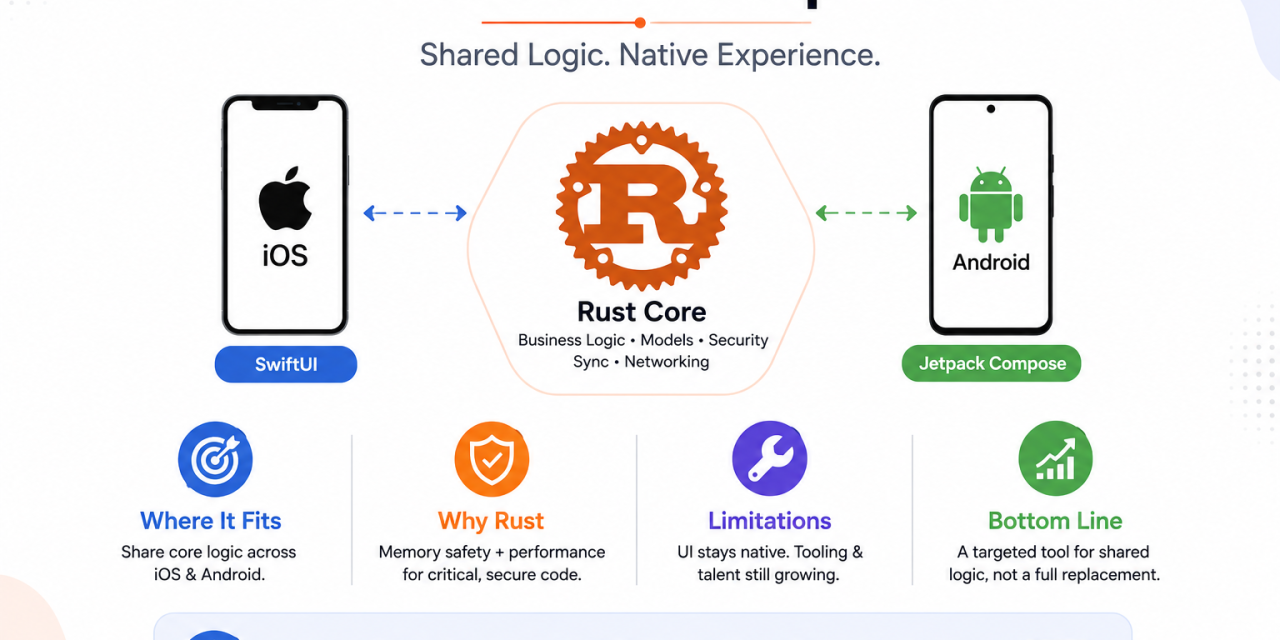
Rust’s strongest mobile use case in 2026 remains sharing core business logic, data models, validation rules, cryptography, networking and sync logic, across iOS and Android without maintaining two separate implementations that inevitably drift apart over time. Messaging and productivity apps handling complex local-first data sync and encryption have been particularly early and enthusiastic adopters, since Rust’s memory safety guarantees matter considerably more for security-sensitive cryptographic code than for typical UI logic. Tooling built specifically for this pattern, most notably Mozilla’s UniFFI project, has matured to the point of automatically generating the binding code needed to call a shared Rust library from Kotlin or Swift, removing what used to be a substantial and error-prone manual integration burden.
The Real Limitations in Production
Despite genuine progress, Rust mobile adoption still runs into real friction that pure native development doesn’t face. UI development itself remains squarely native territory, SwiftUI and Jetpack Compose have no serious Rust equivalent, and nobody in the ecosystem is seriously suggesting Rust should build actual mobile interfaces rather than the logic underneath them. Build tooling and cross-compilation for mobile targets, while considerably improved from a few years ago, still add real complexity to a project’s build pipeline compared to a purely native Kotlin or Swift codebase, and the pool of mobile engineers genuinely comfortable writing production Rust remains meaningfully smaller than the pool of native iOS and Android developers, which matters for hiring and long-term maintenance.
How Teams Are Actually Using It in 2026
The pattern that’s emerged among teams successfully using Rust on mobile isn’t a wholesale platform shift, it’s a shared-core architecture: a Rust library handles data models, business rules, and any performance- or security-critical logic, while thin native UI layers in SwiftUI and Jetpack Compose call into that shared core through generated bindings. This mirrors almost exactly the pattern that’s emerged with WebAssembly and on-device AI this year, targeted adoption of a specialized technology for a specific, well-bounded problem, rather than a full replacement of the existing native development stack. Teams adopting this pattern successfully tend to have a strong systems programming background already on staff, since debugging cross-language boundary issues between Rust and native Kotlin or Swift code still requires genuine expertise in both environments.
Should Your Team Actually Adopt It
For teams with genuinely complex business logic, data sync, or cryptographic requirements that need to behave identically and reliably across iOS and Android, evaluating a shared Rust core remains a legitimate and increasingly well-supported option in 2026, particularly given how much UniFFI and similar tooling have matured. Teams building a fairly standard app with straightforward platform-specific logic and no serious cross-platform consistency requirements are unlikely to see meaningful benefit from introducing Rust, since the tooling complexity and hiring challenges aren’t justified without a genuine shared-logic problem to solve. As with WebAssembly and on-device AI, the right question isn’t whether Rust is a good technology, it clearly is for the right use case, but whether a specific app actually has the kind of cross-platform logic consistency problem that a shared Rust core was built to solve.
Looking at the broader pattern across this year’s coverage of emerging mobile technologies, Rust’s trajectory closely mirrors both WebAssembly and on-device AI: genuine, meaningful progress for a specific, well-bounded category of problem, rather than the platform-replacing shift some of its most enthusiastic early advocates predicted. The companies getting real value from Rust on mobile are treating it as a targeted tool for sharing critical, correctness-sensitive logic across platforms, not as a replacement for native UI development, which remains firmly the domain of SwiftUI and Jetpack Compose. As tooling like UniFFI continues to mature and more mobile engineers gain genuine Rust experience, expect the practical footprint of shared Rust cores to keep growing steadily, but a wholesale replacement of Kotlin and Swift for anything beyond shared core logic looks unlikely on any near-term horizon.
Conclusion
Rust in mobile development has made real, credible progress in 2026, and for teams with genuine cross-platform logic consistency needs, particularly around data sync, security, and complex business rules, it remains one of the more compelling architectural options available. It hasn’t replaced Kotlin and Swift, and the honest evidence suggests it isn’t trying to in any comprehensive sense, but as a targeted solution for sharing critical logic across iOS and Android, Rust has firmly earned a place in a well-informed mobile architect’s toolkit this year.