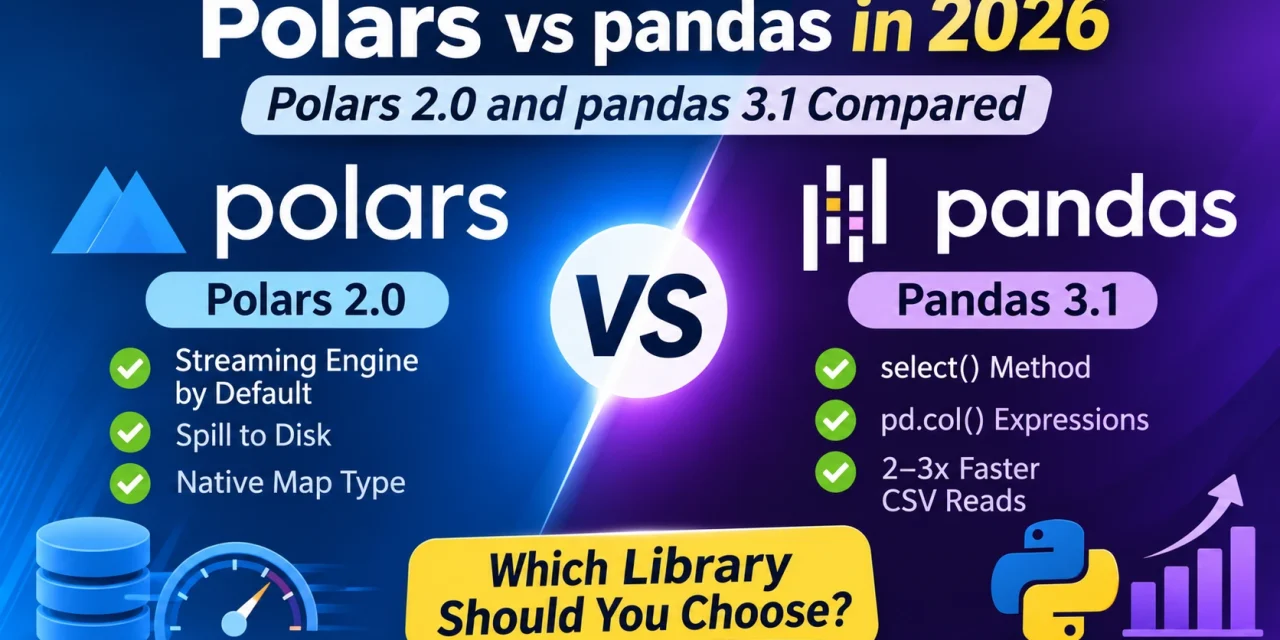
The Polars vs pandas question just got harder to answer. Polars 2.0, released on 6 October, makes its streaming engine the default and can now spill large jobs to disk. Two weeks later, pandas 3.1 arrived with a Polars-style select() method and a much faster CSV reader. If you write Python for data analysis, ETL or machine learning, both upgrades can break or speed up your code, so it pays to know what changed.
What Is New in Polars 2.0
The headline change is that calling collect() on a LazyFrame now runs on the streaming engine by default. Instead of loading the full dataset into memory, Polars processes it in batches, which helps on laptops and modest cloud servers.
- Spill to disk: out-of-core processing is on by default, starting at about 80% of RAM, with a default disk budget of 64 GB. It covers sorts, window functions and many expressions for now; out-of-core joins and group-bys are on the roadmap.
- Better SQL: the team now treats SQL as a first-class way to query Polars.
- Smarter optimiser: join reordering and improved common-subplan elimination.
- New Map data type: Arrow, Parquet and Iceberg map columns now load as a native Map instead of a list of key-value structs.
In its own TPC-H and TPC-DS-derived benchmarks, the Polars team reported that it was fastest on all but one test against DuckDB and DataFusion. Treat these as vendor numbers and benchmark your own workloads.
Source: Polars Blog
Polars 2.0 Breaking Changes to Check First
The major version bump exists mainly because of row order. The streaming engine does not guarantee row order for joins, group_by and unpivot unless you pass maintain_order=True or sort explicitly. Code that quietly relied on order can now return differently ordered results.
- Horizontal concat on frames of different heights now raises an error; use how=”horizontal_extend” for the old behaviour.
- String-to-date and integer-to-categorical casts now raise errors; use .str.to_date() or the .cat
- profile() and the DataFrame interchange protocol have been removed.
- explode() on empty lists now returns zero rows instead of a null row.
Run collect_schema() on your pipelines to catch type mismatches before any data is processed, and read the official upgrade guide before bumping versions in production.
Source: Polars Upgrade Guide
What pandas 3.1 Brings
pandas 3.1, released on 22 October, borrows ideas that made Polars popular. The new DataFrame.select() method works with pd.col() expressions, so you can pick and compute columns in one readable call. filter() also gains a cond argument that accepts the same expressions.
- Faster read_csv(): single-threaded reads are typically two to three times faster than in pandas 3.0.
- Parallel reads: local, uncompressed CSV files of 5 MB or more are read in parallel by default, capped at six threads.
- Deprecations: inplace=True is deprecated for methods such as drop, rename and sort_values; reassign the result instead.
Source: pandas Documentation
Polars vs pandas: Which Should You Use?
| Factor | Polars 2.0 | pandas 3.1 |
| Best for | Large files, ETL pipelines, limited RAM | Notebooks, quick analysis, legacy code |
| Execution | Lazy, streaming by default | Eager, in memory |
| Larger-than-RAM data | Spill to disk for supported operations | Not built in |
| Expression syntax | pl.col() | New pd.col() and select() |
| Cost | Free, open source | Free, open source |
For Indian students and freshers targeting data analyst or data engineer roles, pandas remains the library you will meet most often in tutorials and existing company code. Learning Polars alongside it is a useful edge, especially for teams running pipelines on small cloud instances where memory costs money. Startups processing large logs or transaction data can test Polars on one heavy job first.
The Takeaway
The Polars vs pandas gap is narrowing in syntax but widening in scale. Pick Polars 2.0 when data size and speed matter, and stay with pandas 3.1 when compatibility and familiarity matter more. Whichever you use, pin versions, run your tests and fix deprecation warnings before upgrading.
Sources
- Polars Blog — Polars 2.0 release announcement (Ritchie Vink) — https://pola.rs/posts/release-polars-2/ — Published: October 6, 2026
- Polars Documentation — Upgrading to Polars 2 — https://docs.pola.rs/releases/upgrade/2/ — Published: Undated documentation page (accessed November 19, 2026)
- Polars Blog — Announcing Polars 2.0 release candidate — https://pola.rs/posts/announcing-polars-2/ — Published: September 2, 2026
- AlternativeTo — Polars 2.0 makes streaming and disk spilling the default — https://alternativeto.net/news/2026/10/polars-2-0-makes-streaming-and-disk-spilling-the-default/ — Published: October 7, 2026
- pandas Documentation — What’s new in 3.1.0 (October 22, 2026) — https://pandas.pydata.org/docs/whatsnew/v3.1.0.html — Published: October 22, 2026
- Real Python — Python 3.15 Ships and Other Python News for November 2026 — https://realpython.com/python-news-november-2026/ — Published: November 2026