Google Play Store policy evolves continuously, but 2026 has brought a cluster of significant policy changes that affect how Android apps can collect data, target advertising, handle subscription cancellations, and disclose the use of AI-generated content. For developers who publish on the Play Store – whether as their primary livelihood or as a side project – staying current with these policies is not optional. Apps that violate updated policies face removal from the store, which can be devastating for businesses built around Android distribution.
AI-Generated Content Disclosure Requirements
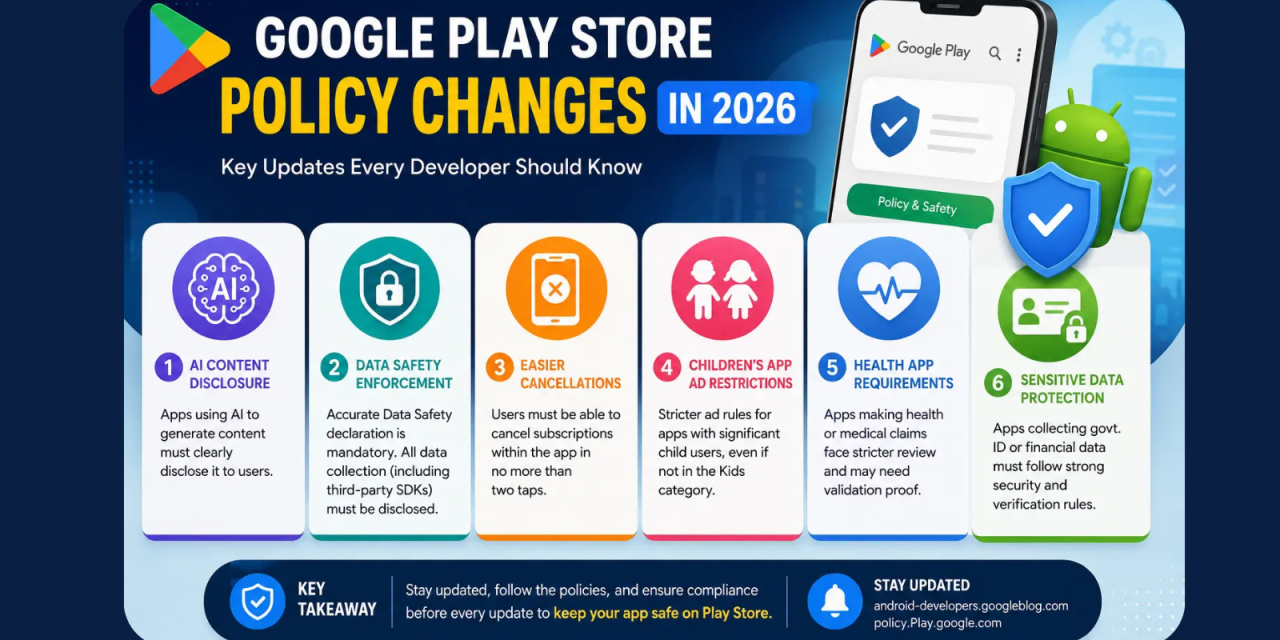
The most discussed new policy in 2026 requires apps that use AI to generate content displayed to users to clearly disclose this fact within the app experience. This applies most directly to apps that generate text, images, audio, or video using AI models and present that content to users as part of the app’s core function – chatbot apps, AI writing tools, AI image generators, and AI voice applications all fall clearly within scope.
The disclosure requirement does not specify exactly how disclosure must appear, but it requires that users can reasonably understand that AI generation is involved without needing to investigate beyond what the app itself communicates. Apps that embed undisclosed AI generation into their content without any indication face policy violation findings during review and during ongoing compliance checks of published apps.
For Indian developers building AI-assisted content tools – a rapidly growing category – this policy is particularly important. Apps that generate personalised content, automated marketing copy, or AI-driven recommendations for Indian language users must ensure their disclosure covers the AI generation component clearly in relevant languages.
Data Safety Section Enforcement Tightened
The Data Safety section in Play Store listings, which requires developers to self-declare what data their app collects, how it is used, whether it is shared with third parties, and whether users can request deletion, is now subject to more active enforcement in 2026. Google has increased the frequency and depth of auditing app behaviour against declared Data Safety information.
Apps found to be collecting or sharing data in ways inconsistent with their Data Safety declaration face immediate policy violation notices and potential removal while the issue is being resolved. The most common compliance failures found in the 2026 auditing cycle involve advertising SDKs collecting device identifiers that developers had not accounted for in their declarations, and analytics tools sharing derived data with advertising partners beyond what was disclosed.
The practical requirement for developers is to audit not just their own code but every third-party SDK included in their app, and to include all data collection by third-party libraries in the Data Safety declaration rather than only data explicitly collected by the developer’s own code.
Subscription Cancellation Policy – Easier Cancellations Required
Google introduced strengthened requirements around subscription cancellation in 2026, effective for all apps offering subscriptions through Google Play billing. Users must now be able to cancel their subscription from within the app itself in no more than two taps from the app’s main subscription management screen. Apps that previously required users to navigate to the Play Store or a separate website to cancel subscriptions must now provide the in-app cancellation path.
The policy also prohibits any design patterns that obscure or discourage cancellation – hiding the cancellation option behind promotional offers, requiring cancellation acknowledgement screens that imply negative consequences from cancelling, or adding additional steps beyond the two-tap maximum are all cited as non-compliant patterns. For subscription apps with high churn concerns, this policy change removes some of the dark pattern tools that were previously used to reduce cancellation rates.
Children’s App Advertising Restrictions Extended
The restrictions on advertising in apps with audiences that include children have been broadened in 2026. Previously, the restrictions applied specifically to apps designated as being for children in the Families section of the Play Store. The updated policy extends advertising restrictions to any app where children make up a significant portion of the actual user base, regardless of the app’s category designation.
This determination is based on actual usage patterns rather than solely on the declared target audience – apps where data signals suggest a significant child user base are expected to comply with child-directed advertising restrictions including prohibitions on interest-based advertising and data collection for advertising purposes. For general-audience apps that are popular with children without being specifically designed for them, this policy requires assessment of actual user demographics and appropriate advertising configuration.
Health App Requirements – Medical Claims Policy
Apps in the health and wellness category that make any claims about diagnosing, treating, or preventing medical conditions are subject to more stringent review requirements in 2026. Claims that specific app features can diagnose medical conditions from user-provided information, even when framed as informational rather than diagnostic, now trigger additional review steps and frequently require supporting documentation of clinical validation.
AI-powered symptom checkers and health monitoring apps have been particularly affected. The use of AI to analyse user health data and provide personalised health guidance has been reclassified in several cases from informational to medical advisory, which triggers the higher regulatory review standard. Developers building in this space should review their app descriptions, marketing copy, and in-app content carefully against the updated health app policy before their next submission.
Government ID and Financial Data Requirements
Apps that collect government identification documents – Aadhaar numbers, passport details, PAN cards – or significant financial account data are now subject to additional verification requirements before and during Play Store listing. Developers must demonstrate a legitimate business reason for collecting this data and implement specific security requirements including end-to-end encryption and access controls that meet Google’s updated standards.
For Indian developers building financial services apps, UPI payment tools, or verification services, these requirements align with NPCI and RBI regulatory expectations but add a Play Store compliance layer that must be documented and maintained separately from regulatory compliance with Indian financial regulations.
Where to Stay Current on Policy Changes
Monitor policy changes directly at the Android Developer Policy Center and subscribe to the Android Developers Blog for advance notice of upcoming policy changes. For Indian developer community discussion of policy impacts, the Android Developers India community groups and the Play Store developer forums are the most active sources of peer discussion on policy interpretation