Solutions architect has quietly become one of the most sought-after roles in India’s technology sector, sitting at the intersection of deep technical knowledge and the kind of big-picture thinking that senior engineers eventually grow into. As Indian IT companies and homegrown product startups alike take on increasingly complex cloud migrations and system redesigns, the demand for professionals who can design scalable, secure, and cost-effective architecture has grown well beyond what the current talent pool can supply. This has made solutions architect one of the more reliable paths toward both strong compensation and genuine influence over how major systems get built. For engineers wondering how to make the jump from writing code to designing the systems that other engineers build on, this guide breaks down what the role actually involves and how to get there in 2026’s Indian tech landscape.
What a Solutions Architect Actually Does
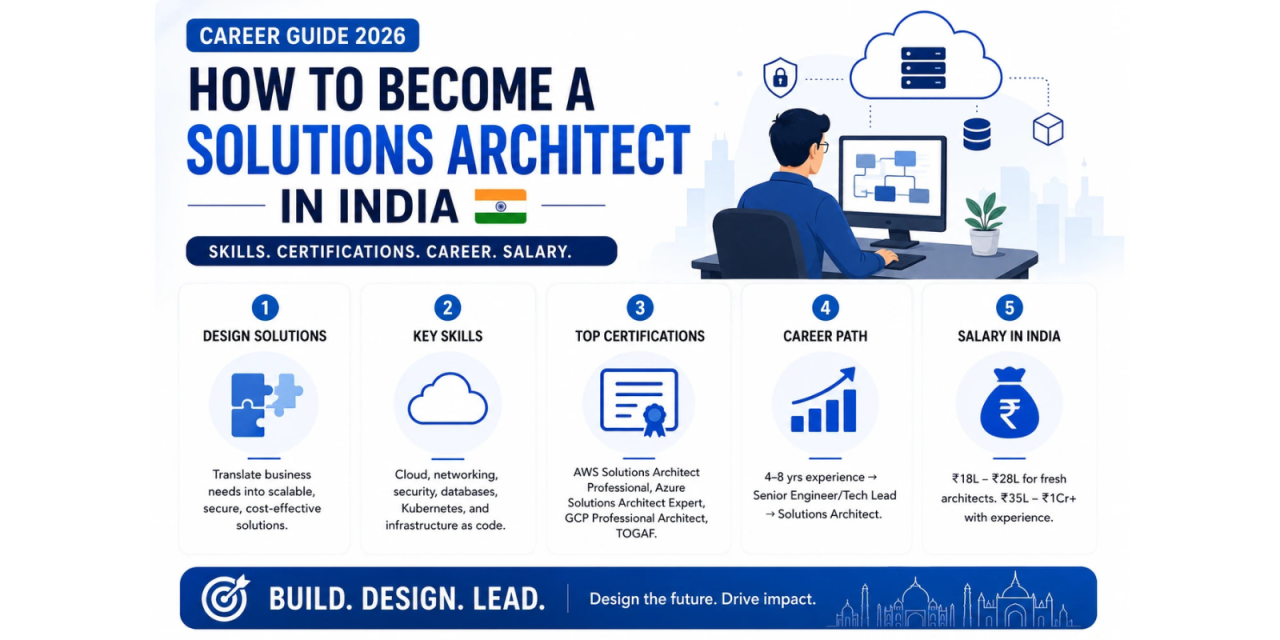
A solutions architect is responsible for designing the overall technical structure of a system or set of systems, translating business requirements into a concrete technical plan that development teams can execute against. This involves choosing the right combination of cloud services, databases, integration patterns, and security controls to meet both functional needs and non-functional requirements like scalability, cost, and compliance. Unlike a pure software engineer role, a solutions architect spends a significant portion of their time communicating with stakeholders across business and technical teams, translating between the two groups and making sure everyone is aligned on tradeoffs before a single line of code gets written. In Indian IT services firms, solutions architects often oversee client-facing projects directly, while in product companies the role tends to focus more on internal platform architecture.
Core Technical Skills Needed
A strong foundation in at least one major cloud platform, typically AWS, Azure, or Google Cloud, is close to non-negotiable for solutions architect roles in India’s current market, since the overwhelming majority of new systems are being built cloud-first. Beyond cloud fundamentals, a working understanding of networking, security architecture, database design across both relational and NoSQL systems, and container orchestration with tools like Kubernetes has become expected rather than optional. Experience with infrastructure-as-code tools like Terraform is increasingly a baseline requirement rather than a differentiator, since most modern architecture work assumes infrastructure will be defined and version-controlled as code from the start. A background in software development, ideally several years of hands-on coding experience, remains important because it builds the credibility and practical judgment needed to design systems that are actually implementable.
Certifications Worth Pursuing
Cloud certifications carry real weight in India’s hiring market, particularly the AWS Certified Solutions Architect Professional, Microsoft Azure Solutions Architect Expert, and Google Cloud Professional Cloud Architect credentials, all of which are widely recognized by both product companies and IT services firms. These certifications signal a structured understanding of architecture principles even to hiring managers unfamiliar with a candidate’s specific project history, which matters a great deal when transitioning roles or companies. Beyond cloud-specific certifications, TOGAF certification remains respected in larger enterprise environments where formal architecture frameworks and governance processes are heavily used. Many successful architects pursue certifications from more than one cloud provider over their career, since multi-cloud and hybrid-cloud projects have become increasingly common across Indian enterprises.
Typical Career Path and Salary Expectations
Most solutions architects arrive at the role after four to eight years of hands-on software development or systems engineering experience, often first moving into a senior engineer or technical lead position before making the jump into architecture specifically. Entry-level solutions architect roles in India’s major tech hubs currently see salaries ranging from roughly 18 to 28 lakhs per annum, with experienced architects at product companies or multinational firms commanding anywhere from 35 lakhs well into the range of a crore or more depending on company size and specialization. Specializing in a high-demand niche such as cloud security architecture, data platform architecture, or AI infrastructure tends to command a further premium over generalist architecture roles. Freelance and consulting solutions architect work has also grown steadily, with experienced professionals taking on short-term architecture review or greenfield design engagements for multiple clients simultaneously.
For engineers currently working as developers who want to make this transition, the most effective path tends to combine deliberate exposure to architecture decisions on current projects, even in a supporting capacity, with structured certification study on the side. Volunteering to lead the technical design phase of a project, rather than only implementing someone else’s design, is one of the fastest ways to build the specific judgment that separates a strong developer from a credible architect candidate. Building a portfolio of documented architecture decisions, even from smaller personal or open-source projects, can also help demonstrate this thinking to prospective employers who may not otherwise see that side of a candidate’s work history.
Conclusion
The solutions architect role sits at a genuinely interesting point in a technology career, combining deep technical expertise with the kind of cross-functional communication and business understanding that opens doors to senior leadership over time. For engineers in India willing to invest in both the technical depth and the certifications that validate it, 2026 remains a strong year to pursue this path, with demand across both IT services and product companies showing no signs of slowing down.