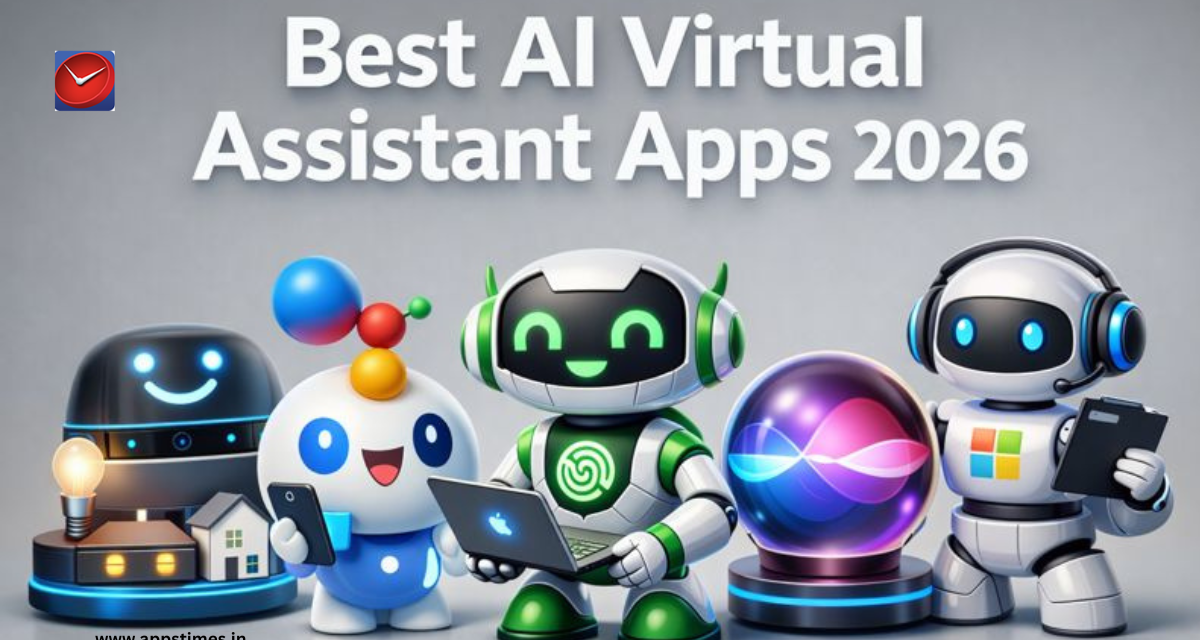
The AI virtual assistant revolution has transformed daily digital interactions, with the global market projected to reach $42 billion by 2026 growing exponentially from conversational chatbots to proactive personal companions. From controlling smart homes and managing schedules to answering complex questions and drafting emails, AI assistants have evolved from simple command-takers into sophisticated cognitive partners understanding context, learning preferences, and anticipating needs
Why AI Virtual Assistant Apps Are Essential
The best AI virtual assistant apps 2026 represent a fundamental shift from reactive “doers” to generative “thinkers” powered by large language models. Traditional assistants like Alexa and Google Assistant excel at automation and information retrieval through commands like “set a timer” or “what’s the weather.” New generative AI assistants powered by GPT-4o and Claude 3 handle complex, ambiguous tasks like refactoring entire code functions or writing comprehensive articles.
By 2026, AI personal assistants manage over 3.5 billion voice searches daily, with conversational agents processing over 1 billion complex linguistic commands. Smart home integration has reached 50% of households using voice-controlled assistants, making these tools indispensable for modern living. The technology has matured to provide reliable, contextual understanding reducing errors while maintaining ongoing dialogue rather than treating each request in isolation
Top 6 AI Virtual Assistant Apps 2026 Reviewed
1. Amazon Alexa – Best for Smart Home Control

Amazon Alexa dominates smart home automation with unrivaled compatibility across thousands of third-party devices, serving as the central hub for home control. Alexa generated $10.5 billion revenue in 2024 through deep e-commerce and smart home integration.
Best For: Smart home control, music playback, shopping, routines automation, hands-free voice computing
Pricing: Free main service, costs for Echo devices, Alexa+ generative AI free for Prime subscribers
Key Features: Works with thousands of brands and devices, massive Skills library with tens of thousands of voice apps, custom multi-step Routines with single commands, Alexa+ premium upgrade for natural conversations, shopping integration with Amazon, music and podcast streaming
Standout Feature: Unrivaled smart home leadership with more device compatibility than any competitor creates comprehensive ambient computing ecosystem
Alexa Skills extend functionality dramatically through third-party voice applications. Create complex Routines like “Good morning” triggering lights, coffee maker, news briefing, and calendar review simultaneously. The Alexa+ generative AI upgrade enhances conversation naturalness, though core intelligence has stagnated according to user feedback compared to newer LLM-based assistants.
Integration with Amazon’s shopping platform enables voice-based purchasing, reordering household essentials, and tracking deliveries. Echo devices ranging from $30-300 provide varied hardware options matching different use cases and budgets.
Download: Amazon Alexa for iOS | Amazon Alexa for Android
2. Google Assistant – Best for General Knowledge Questions
Google Assistant leverages Google’s Knowledge Graph and Search connection, making it historically the smartest AI voice assistant for answering factual questions accurately. The assistant handles general queries better than competitors through superior information access and processing.
Best For: Answering factual questions, Google ecosystem integration, voice recognition, personalized responses
Pricing: Free, bundled with Android devices and Google Home hardware
Key Features: Superior general knowledge answering, deep Google Maps/Calendar/YouTube integration, Voice Match for personalized multi-user responses, excellent voice recognition accuracy, smart home control, hands-free calling and messaging
Standout Feature: Most intelligent assistant for Q&A consistently outperforming competitors in understanding and accurately answering factual questions
Google Assistant’s future involves transitioning functions to Gemini as Google consolidates AI capabilities. The ecosystem connection provides seamless experiences across Google services—checking calendar events, navigating via Maps, playing YouTube videos, all through natural conversation.
Voice Match technology recognizes different household members, providing personalized calendar information, playlists, and responses tailored to individual preferences. The free nature bundled with Android smartphones provides universal accessibility without additional hardware costs.
Download: Google Assistant (Pre-installed on Android, available for iOS)
3. Apple Siri – Best for Apple Ecosystem Integration

Siri offers seamless integration across iPhone, iPad, Mac, Apple Watch, and HomePod creating unified voice control experience throughout Apple’s ecosystem. Recent Apple Intelligence improvements enhance Siri’s contextual understanding and on-device processing capabilities.
Best For: Apple device users, privacy-conscious users, hands-free iOS/Mac control, cross-device continuity
Pricing: Free, bundled with Apple devices
Key Features: Cross-device Apple ecosystem integration, hands-free system actions and app control, enhanced privacy through on-device processing, Shortcuts for workflow automation, HomeKit smart home integration, multilingual support
Standout Feature: On Apple devices, the best assistant is the one already integrated understanding what’s on your screen with unmatched ecosystem continuity
Siri benefits from Apple’s privacy-first approach, processing many requests on-device without sending data to cloud servers. Shortcuts enable complex automation workflows triggered by voice commands. Integration with Apple HomeKit provides smart home control matching Alexa and Google Assistant capabilities.
Recent improvements expand Siri’s contextual awareness, understanding screen content and providing relevant assistance. App Intents enable deeper third-party app integration, allowing voice control beyond Apple’s native applications.
Download: Siri (Pre-installed on all Apple devices)
4. ChatGPT – Best Conversational AI Assistant

ChatGPT became the fastest app reaching 1 billion downloads in July 2026, transforming from chatbot into versatile personal assistant for writing, coding, research, and complex problem-solving. With 546.15 million monthly active users and over 305 million premium subscribers globally, ChatGPT leads the generative AI assistant revolution.
Best For: Content creation, coding assistance, research, brainstorming, learning, complex reasoning tasks
Pricing: Free with GPT-3.5, ChatGPT Plus $20/month for GPT-4 access
Key Features: Natural conversation with context retention, handles follow-up questions mid-conversation, coding and debugging assistance, content generation across formats, research and analysis, vision capabilities analyzing images, voice conversation mode
Standout Feature: GPT-4-powered conversations handle ambiguous, complex tasks through reasoning and synthesis unavailable in traditional command-based assistants
ChatGPT’s weekend usage increase signals expanding use cases beyond work-focused tasks into personal assistance, entertainment, and casual conversation. The platform adapts to users rather than requiring precise command phrasing, reversing the human-machine dynamic that limited earlier assistants.
Voice mode enables natural spoken conversations, making ChatGPT accessible while driving, cooking, or otherwise hands-occupied. Integration with mobile keyboards and third-party apps extends ChatGPT’s utility across devices and contexts.
Download: ChatGPT for iOS | ChatGPT for Android
5. Microsoft Copilot – Best for Productivity Integration

Microsoft Copilot integrates across Office 365, Edge browser, and Windows providing AI assistance embedded within productivity workflows. The assistant helps with document creation, research, data analysis, and workflow automation across Microsoft’s ecosystem.
Best For: Office workers, Microsoft 365 users, enterprise productivity, document assistance
Pricing: Free basic version, Microsoft 365 Copilot from $30/user/month
Key Features: Integrated within Word/Excel/PowerPoint/Teams, document drafting and editing assistance, data analysis and visualization, meeting summarization, email composition, Edge browser integration, enterprise security and compliance
Standout Feature: Embedded productivity assistance directly within work tools eliminates context switching between assistant and applications
Copilot analyzes Excel data generating insights and visualizations, drafts PowerPoint presentations from prompts, summarizes lengthy Word documents, and captures Teams meeting notes automatically. This integration delivers value during actual work rather than requiring separate assistant consultation.
Enterprise deployment includes security, compliance, and data governance features essential for business environments. Microsoft’s position in corporate IT infrastructure provides Copilot advantages in enterprise adoption.
Download: Microsoft Copilot for iOS | Microsoft Copilot for Android
6. Meta AI – Best for Social Media Integration

Meta AI integrates deeply within WhatsApp, Instagram, and Facebook enabling assistance directly within chats and feeds. Users ask questions, generate text, and seek explanations without leaving social platforms they already use daily.
Best For: Social media users, Meta ecosystem integration, visual context through smart glasses
Pricing: Free within Meta platforms
Key Features: WhatsApp/Instagram/Facebook integration, text generation and explanation, image analysis and creation, real-time visual context via Meta smart glasses, conversational assistance within chats, search and information retrieval
Standout Feature: Embedded within platforms people already use daily eliminates need for separate app downloads or context switching
Meta AI appears directly in chat interfaces, enabling seamless assistance during conversations. Ask questions, generate creative content, or analyze shared images without leaving messaging apps. Meta smart glasses extend AI to real-world visual context, enabling questions about what users see.
The strategy of embedding AI within existing high-usage platforms ensures broad reach without requiring user behavior changes or app adoption hurdles facing standalone assistants.
Download: Meta AI (Integrated within WhatsApp, Instagram, Facebook apps)
How to Choose the Right AI Virtual Assistant
Primary Use Case Requirements
Smart home control requires Alexa’s device compatibility. Factual knowledge needs favor Google Assistant’s search integration. Apple users benefit from Siri’s ecosystem integration. Complex reasoning and content creation suit ChatGPT. Productivity tasks match Copilot’s Office integration.
Device Ecosystem Considerations
Android users naturally pair with Google Assistant. Apple devices integrate seamlessly with Siri. Amazon devices center on Alexa. Cross-platform flexibility favors ChatGPT and standalone assistants accessible across ecosystems.
Privacy Preferences
Privacy-conscious users appreciate Siri’s on-device processing and Apple’s privacy commitments. Cloud-dependent assistants like Alexa and Google Assistant offer less privacy but broader capabilities requiring server processing.
Budget and Subscription Willingness
Free assistants (Alexa, Google, Siri, Meta) provide substantial functionality without costs. Premium subscriptions ($20-30 monthly) for ChatGPT Plus and Microsoft Copilot unlock advanced capabilities for power users.
Traditional vs Generative AI Needs
Traditional reactive assistants (Alexa, Google, Siri) excel at automation, simple queries, and device control. Generative AI assistants (ChatGPT, Copilot, Gemini) handle complex reasoning, content creation, and nuanced conversations.
The Future of AI Virtual Assistants
Artificial intelligence assistants will achieve true proactive behavior, anticipating needs before conscious requests through pattern analysis and contextual awareness. Memory systems will maintain long-term understanding of preferences, projects, and goals eliminating repeated context provision currently frustrating users.
Multimodal capabilities combining text, voice, vision, and action will create comprehensive assistance across sensory inputs. Integration will deepen across smart glasses, vehicles, wearables, and ambient computing devices making AI assistance omnipresent.
The paradox of sounding intelligent while lacking dependability will resolve as assistants build trust through consistent, accurate, contextual responses maintaining continuity across sessions and years
FAQ: AI Virtual Assistant Apps
Q: Which is the smartest AI assistant?
A: ChatGPT and Google Assistant lead for different reasons—ChatGPT excels at complex reasoning and conversation, while Google Assistant dominates factual knowledge through Search integration.
Q: Can I use multiple AI assistants simultaneously?
A: Yes—many users combine assistants, using Alexa for smart home, Google for knowledge, and ChatGPT for complex tasks. Each excels in specific domains.
Q: Are AI assistants free to use?
A: Most ecosystem assistants (Alexa, Google, Siri) are free. ChatGPT offers free tier with paid Plus at $20/month. Copilot requires Microsoft 365 subscription for full features.
Q: How do AI assistants protect privacy?
A: Privacy varies—Siri emphasizes on-device processing, while cloud-based assistants (Alexa, Google) require more data sharing. Review each platform’s privacy policies carefully.
Q: Will AI assistants replace human workers?
A: AI assistants augment rather than replace humans, handling routine tasks while humans focus on complex decision-making, creativity, and interpersonal work requiring emotional intelligence.
Conclusion
The best AI virtual assistant apps 2025 span from smart home champions like Alexa to conversational powerhouses like ChatGPT, each excelling in specific domains. The evolution from rule-based commands to natural language understanding powered by large language models has transformed assistants from novelty to necessity.
Whether managing homes through Alexa, answering questions via Google Assistant, integrating ecosystems with Siri, or handling complex tasks through ChatGPT, these AI companions enhance productivity, convenience, and capability. Download your preferred assistants today and experience the cognitive partnership revolutionizing human-computer interaction.
For more insights on AI innovation and app development, explore our guides on trending app ideas for 2025 and AI-powered applications reshaping digital experiences