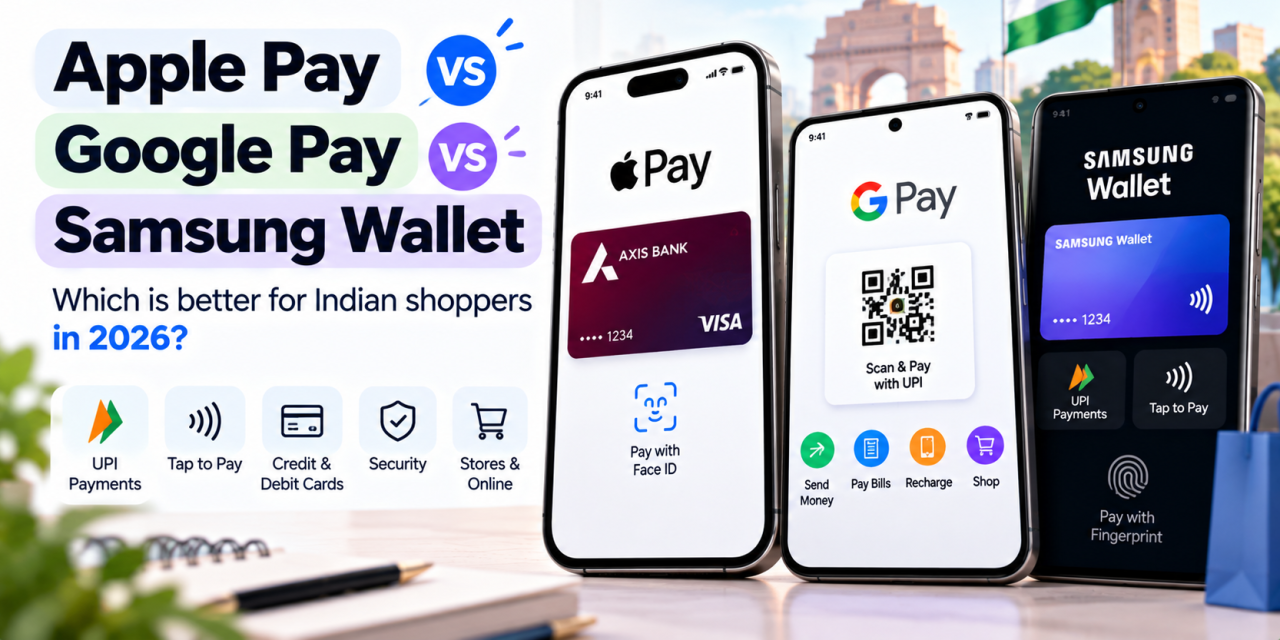
Apple Pay vs Google Pay is finally a real question for Indian shoppers. Apple Pay went live in India at the end of September 2026, but only for Axis Bank Visa and Mastercard credit cards, and with no UPI at all. So if you carry an iPhone and pay by UPI every day, should you change anything? Here is how the new entrant compares with Google Pay and Samsung Wallet.
What Apple Pay Offers in India Right Now
Apple Pay is built into the Wallet app, so there is nothing extra to download. You add a card in Wallet or through the Axis Bank mobile app, then pay with Face ID, Touch ID or your passcode.
- Devices: iPhone XR or later on iOS 18, iPad, and Apple Watch Series 6 or later. Mac support is “coming soon”.
- Where it works: contactless card terminals in stores, in-app purchases and web checkout on iPhone and iPad.
- Launch merchants: Blinkit, Zomato, Croma, Tata 1mg, Ixigo, Chaayos, Reliance brands and Apple Stores, plus gateways such as Razorpay, PayU, Juspay, Pine Labs and Paytm.
The gaps are big. RuPay cards, debit cards and cards from HDFC Bank, ICICI Bank and SBI Card are not supported. TechCrunch reports that those lenders are still negotiating commercial terms, with Apple said to charge about 0.2% per transaction.
Google Pay: The UPI-First Alternative
Google Pay is a free app on both Android and iPhone, and its core job is UPI. You can scan any UPI QR code, send money to friends, pay bills and recharge your phone. A linked RuPay credit card can pay merchants through UPI QR codes, though not friends or family.
Card tap-to-pay is where the platform split matters. Google Pay supports tokenised Visa and Mastercard cards from Axis Bank, HDFC Bank, ICICI Bank, SBI, Kotak Mahindra and others, but tapping a card works only on NFC-enabled Android phones. Its newer Tap & Pay on UPI feature is Android-only too. On an iPhone, Google Pay stays a scan-and-pay UPI app.
Samsung Wallet: The Galaxy Option
Galaxy owners get a third choice. Samsung Wallet handles both card tap-to-pay and UPI. Since late 2025 it has allowed UPI payments with a fingerprint or face scan instead of a PIN, online checkout with saved cards, and FOREX cards for travel. AU Small Finance Bank cards were added in November 2025.
Apple Pay vs Google Pay vs Samsung Wallet: Quick Comparison
| Feature | Apple Pay | Google Pay | Samsung Wallet |
| Platforms | iPhone, iPad, Apple Watch | Android, iPhone (UPI only) | Galaxy phones |
| UPI payments | No | Yes | Yes |
| Card tap-to-pay | Axis Bank credit cards only | Many banks, Android only | Yes, multiple banks |
| RuPay cards | No | RuPay credit card on UPI | Not stated |
Which One Should You Use?
UPI accounts for about 84% of India’s digital payment volumes, according to 2025 IMF data cited by Open Magazine. That single number explains why Apple Pay will not replace Google Pay, PhonePe or Paytm for most people this year.
Here is a simple way to decide:
- iPhone user with an Axis Bank credit card: turn on Apple Pay. Tapping your phone or Watch, confirmed with Face ID or Touch ID, is quicker than handing over a card.
- iPhone user with any other bank: keep Google Pay or your usual UPI app. Apple Pay adds nothing until your bank joins.
- Android user: Google Pay covers UPI and card taps in one app. On a Galaxy phone, Samsung Wallet is a strong all-in-one choice.
Apple’s arrival still matters. iPhones held 28% of India’s smartphone market by value in 2025, according to TechCrunch, which gives Apple a sizeable premium audience to win over. Once HDFC Bank, ICICI Bank and SBI Card sign on, Apple Pay becomes a serious card wallet.
The Takeaway
For now, the Apple Pay vs Google Pay debate has a clear answer: Google Pay for UPI, which is most of what Indians pay with, and Apple Pay as a handy extra for Axis Bank cardholders on iPhone. Watch for more banks and RuPay support. That is when the contest becomes a close one.