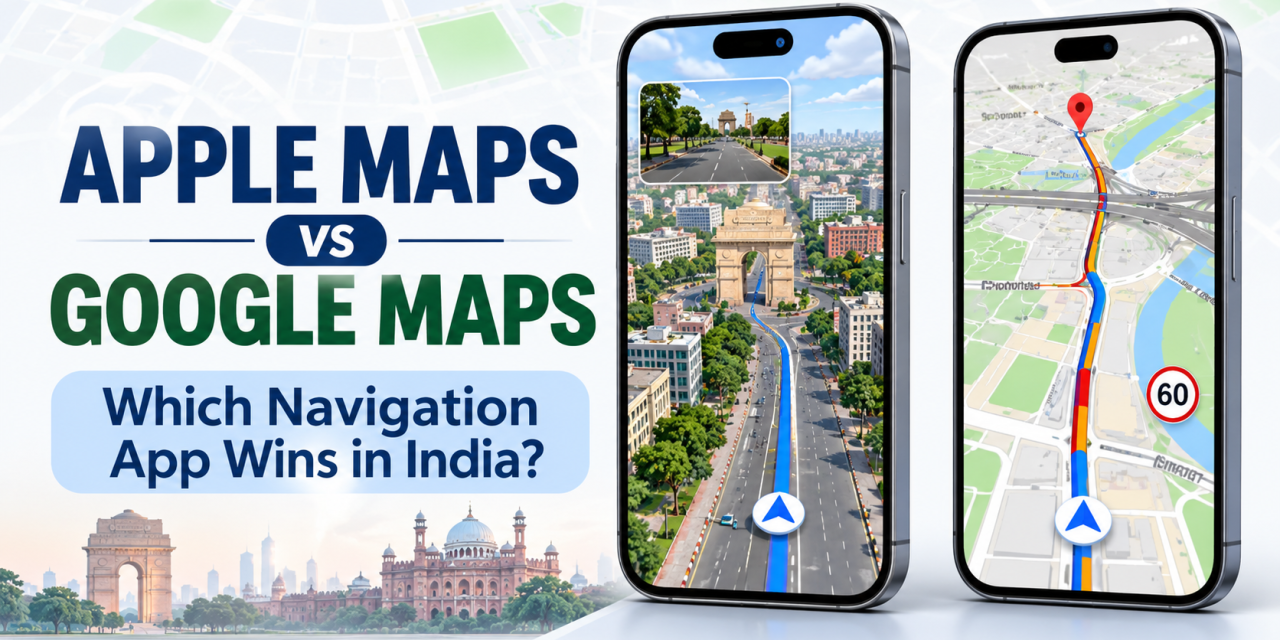
Apple has finally given Indian iPhone users a reason to open Apple Maps. On 18 November, the company rolled out its rebuilt map for India, with 3D landmarks, street-level imagery and directions that say “turn right after the petrol pump” instead of naming a road nobody knows. That makes Apple Maps vs Google Maps in India a fair fight for the first time. Here is how the two apps compare.
What Changed in Apple Maps for India
This is the same redesigned map Apple first launched in the US in 2018, now built out for Indian roads. Turn-by-turn navigation had already reached India in 2019, but the base map lacked detail. The new version adds more detailed roads, buildings, parks and malls, plus over 300 three-dimensional landmarks.
- Landmark-based guidance: directions refer to pillars, traffic lights and petrol pumps, which helps on unnamed lanes.
- Dual-language labels: place names appear in English plus the local language, such as Hindi in Delhi or Marathi in Mumbai. Apple has added Bengali, Gujarati, Kannada, Malayalam, Marathi, Tamil, Telugu, Punjabi, Odia and Urdu to existing English and Hindi support.
- Look Around and AR Walking Directions: street-level imagery comes to India for the first time.
- Driving extras: lane guidance before elevated roads, multi-stop routes with up to 15 stops, Share ETA and hands-free hazard reporting through Siri.
- Transit: route planning and “get off now” alerts in Ahmedabad, Bengaluru, Chennai, Delhi, Hyderabad, Kolkata, Mumbai and Pune, plus Indian Railways.
One catch: dual-language labels and the new landmark guidance need iOS 27.2, iPadOS 27.2, watchOS 27.2 or macOS 27.2 or later. Update before judging the app.
Source: Apple Newsroom India | MacRumors
Where Google Maps Still Leads in India
Google Maps has years of tuning for Indian traffic. In November 2025, Google made India the second market after the US to get Gemini-powered navigation, and it tied up with NHAI for near real-time data on highway closures, diversions and repair work.
It also shows official speed limits in nine cities, including Mumbai, Hyderabad, Kolkata, Jaipur and Gurugram, and gives voice guidance for flyovers. Android users in a few regions, such as Gurugram and Chandigarh, get alerts for accident-prone stretches. In March 2026, Google began rolling out Ask Maps in India, which lets you ask conversational questions about places on Android and iOS.
The bigger advantage is reach. Google Maps runs on Android, iPhone and the web, so your saved places and shared locations work with friends and family whatever phone they carry.
Source: TechCrunch | Google Blog
Apple Maps vs Google Maps: Side-by-Side
| Feature | Apple Maps | Google Maps |
|---|---|---|
| Price | Free | Free |
| Platforms | iPhone, iPad, Mac, Apple Watch, CarPlay | Android, iPhone, web |
| Indian languages | English, Hindi + 10 more, dual labels | Gemini navigation in nine Indian languages |
| Highway data | Siri-based hazard reports | NHAI closures and diversions |
| Speed limits | Not announced for India | Nine cities |
| Street-level imagery | Look Around (new) | Street View |
| Privacy | No sign-in; searches fuzzed within 24 hours | Tied to your Google account |
Which App Should Indian Users Pick?
Android users: nothing changes. Apple does not offer Maps as an Android app, so Google Maps stays your default.
iPhone users in big metros: Apple Maps is now worth a real test, especially for metro and train trips, walking in unfamiliar areas, and drives where landmark directions beat road names. If privacy matters to you, its no-login approach is a genuine plus.
Highway drivers and frequent travellers: keep Google Maps handy. NHAI data, speed limits and years of crowd-sourced traffic still give it the edge on long routes and in smaller towns.
Note: Apple has not published a city-by-city list for Look Around coverage in India, so imagery may vary by area.
The Verdict
The Apple Maps vs Google Maps in India debate is no longer one-sided. Apple has closed much of the gap on map detail, languages and transit, while Google still wins on traffic data, highway alerts and cross-platform reach. Both apps are free, so iPhone owners can simply use Apple Maps for a week of daily commutes and keep whichever one gets them home faster.