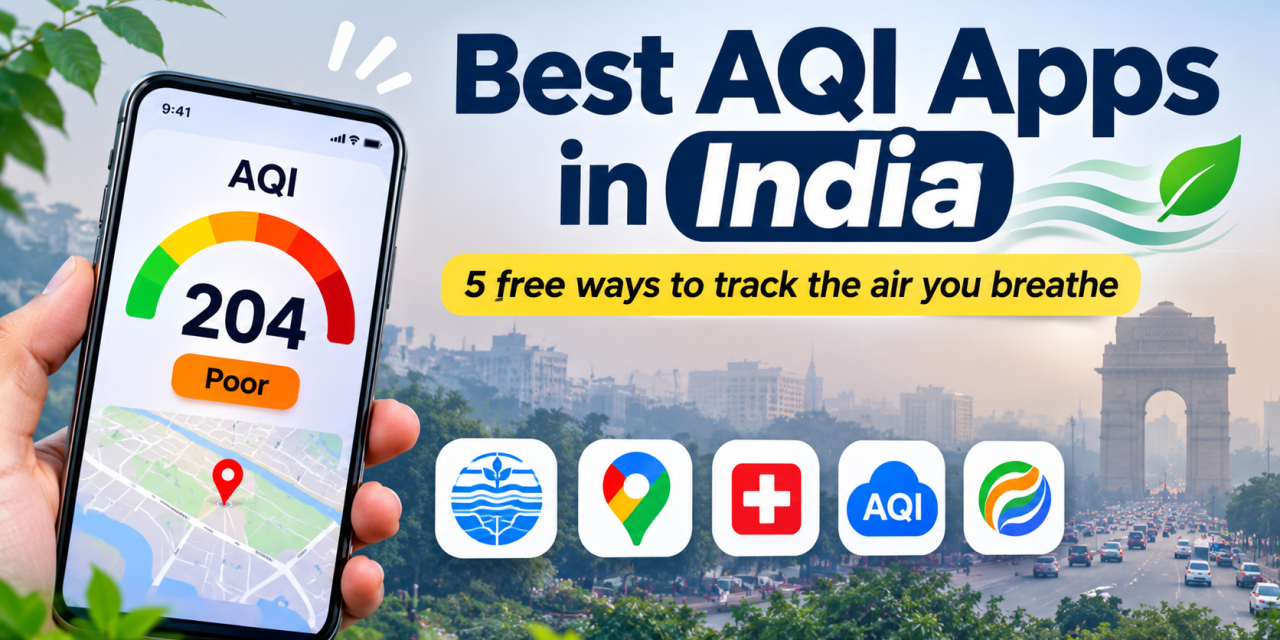
Delhi’s air improved to an AQI of 204 on 17 November, and the Commission for Air Quality Management lifted GRAP Stage III curbs across the NCR after about ten days of hazardous air. Stages I and II still apply, and winter is far from over. The best AQI apps in India help you decide when to step out, when to run the purifier and when to mask up, but they do not all measure the same thing.
Source: The Tribune
Why Two Apps Show Two Different AQI Numbers
India’s official National Air Quality Index (NAQI) runs from 0 to 500 in six bands: Good (0–50), Satisfactory (51–100), Moderate (101–200), Poor (201–300), Very Poor (301–400) and Severe (401–500). It uses 24-hour averages for PM2.5 and PM10, and Delhi’s headline figure is a citywide average across stations.
Private platforms such as IQAir use the US AQI scale, which has different breakpoints, no 500 cap and hourly data. That is why a private app can show a value well above 500 when India’s index has already hit its ceiling. On 8 November, Delhi’s official average was 376 even though several individual stations were already Severe. Before you compare readings, check the scale, the timestamp and the monitoring location.
Source: Business Today, Business Today
The 5 Best AQI Apps in India Right Now
1. Sameer (CPCB)
The Central Pollution Control Board’s own app gives hourly NAQI updates, so its numbers match the official bulletins. Recent versions add location-based AQI with a three-day history, a monthly pollutant calendar and a station map. You can also file a pollution complaint with photos. It is free on Android and iOS, though reviews (2.4 stars on Google Play) flag crashes and slow complaint handling.
Source: Google Play, App Store
2. Google Maps (Air View+)
If you would rather not install anything, Google Maps already shows hyperlocal AQI. Its Air View+ model blends readings from sensors in more than 150 Indian cities with government data, satellite imagery, weather and traffic, and it follows India’s NAQI method. Tap the Layers button and choose Air Quality, or check the Weather widget on the Explore tab.
Source: Google India Blog
3. IQAir AirVisual
AirVisual has more than 5 million downloads and a 4.8-star Play Store rating. It covers 500,000+ locations, offers seven-day pollution and weather forecasts, and gives health tips for sensitive groups such as people with asthma. Remember that it reports on the US scale, so its numbers are not directly comparable with CPCB’s and can look much higher.
Source: Google Play
4. AQI by Purelogic Labs (aqi.in)
This free app from Purelogic Labs shows real-time and historical readings, a station map, a home-screen widget and health advice. It also doubles as a dashboard for Prana Air monitors, which helps if you track indoor air at home or in the office.
Source: App Store
5. AIRWISE-Safar (IITM Pune)
Built on IITM Pune’s SAFAR system, this app adds a one-to-three-day forecast and health advisories, with multi-language and audio support. Coverage is limited to select metro cities, so it is best as a forecasting companion rather than your main tracker.
Source: App Store
Quick Comparison
| App | Platforms | Price | Best for |
|---|---|---|---|
| Sameer | Android, iOS | Free | Official readings, complaints |
| Google Maps | Built into Maps | Free | No extra install |
| IQAir AirVisual | Android, iOS | Free | Forecasts, wide coverage |
| AQI (aqi.in) | Android, iOS | Free | Widgets, indoor monitors |
| AIRWISE-Safar | iOS | Free | Short-term forecasts |
Note: Ratings and features are taken from store listings as of 18 November 2026 and may change with app updates.
Which AQI App Should You Install?
For most readers, a two-app setup works best. Use Sameer or Google Maps for India’s official scale, and add AirVisual for hourly spikes and the week’s forecast. Parents planning school runs and runners picking a morning slot will get the most from that combination.
The takeaway: the best AQI apps in India are free, so the real skill is reading them correctly. Stick to one scale when you compare, check your nearest station rather than the city average, and act on the trend, not a single number.