For years, the narrative around Indian tech was dominated by outsourcing and services work rather than homegrown products competing on the world stage. That’s shifted meaningfully over the past several years, with a growing number of India-built apps finding real users and paying customers well beyond domestic borders. This shift matters for the next generation of Indian developers deciding whether to build for a domestic audience only or aim bigger from day one. Here are five Made-in-India apps that have genuinely earned global traction, not just recognition at home, and what’s driving their growth outside India.
Zoho
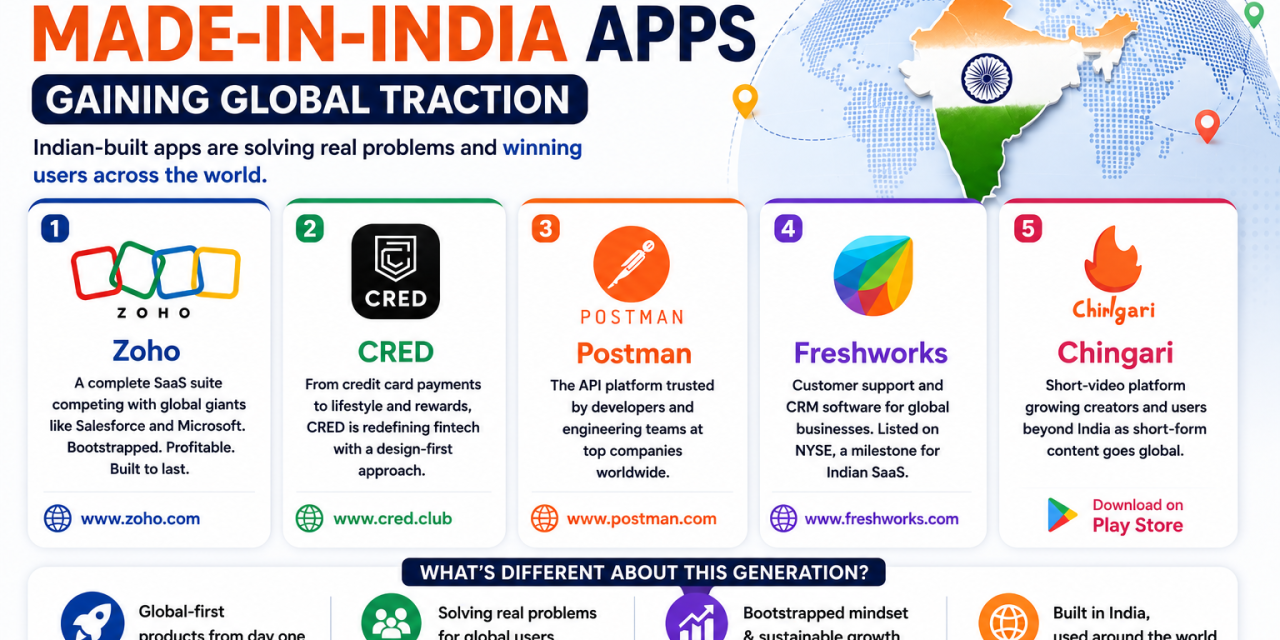
Zoho has quietly built one of the most complete SaaS suites in the world entirely out of India, competing directly with Salesforce and Microsoft across CRM, email, and productivity tools. Its bootstrapped, ad-free growth story has made it a frequently cited example for Indian founders wanting to build sustainably rather than chase endless funding rounds.
CRED
CRED built its early reputation domestically around credit card bill payments and rewards, but its design-first approach and expanding fintech features have started drawing attention from international observers studying how Indian fintech is evolving faster than many mature markets.
Postman
Postman has become genuinely essential infrastructure for software developers worldwide, with its API testing and collaboration platform used by engineering teams at major global companies regardless of where those companies are headquartered. It’s one of the clearest examples of an India-born developer tool achieving true global default status.
Freshworks
Freshworks built its customer support and CRM software with global small and mid-sized businesses as the target market from day one, eventually listing on the US stock exchange, a milestone that gave the broader Indian SaaS ecosystem real international credibility.
Chingari
Chingari emerged as a short-video platform during a period when access to certain international apps was restricted in India, and it has since pushed to expand its creator base and user growth into markets beyond India as short-form video demand keeps climbing globally.
What’s Different About This Generation of Indian Apps
Earlier waves of Indian tech success were concentrated heavily in outsourced services and IT consulting, where the end product was built for a foreign client rather than owned and shipped as an Indian brand. This newer generation of companies is building original products from the ground up, often bootstrapped rather than dependent purely on foreign venture capital, and designing for global usability rather than domestic-first with international as an afterthought. That shift matters for the broader ecosystem, it signals to the next generation of Indian founders and developers that building a genuinely global product from India isn’t the exception anymore, it’s an increasingly proven path.
None of these companies became global by accident, each one solved a real problem well enough that geography stopped mattering to the customers using it. For Indian developers and founders watching from the sidelines, the takeaway isn’t necessarily to copy what these apps built, but to notice that the ceiling for India-built products has moved considerably higher than it was even five years ago. Building with a global user in mind from the very first version, rather than retrofitting international support later, seems to be one of the clearest patterns separating this generation’s breakout successes from apps that stayed permanently domestic. It’s a pattern worth studying closely for any Indian developer with ambitions beyond the local market alone, and one that’s likely to keep repeating as more founders take the global-first approach seriously from day one.