Bharti Airtel will put about ₹1,200 crore into three new facilities in Assam, and fresh data shows how unevenly money is flowing into data centres in India. Disclosed funding for the sector has jumped roughly 11-fold this year, yet four companies have taken almost all of it, while the biggest operators have piled on 43% more debt to build AI-ready capacity. Here is what this week’s numbers tell us about who is building India’s AI infrastructure, and how it is being paid for.
Airtel Takes Its Data Centre Push to the Northeast
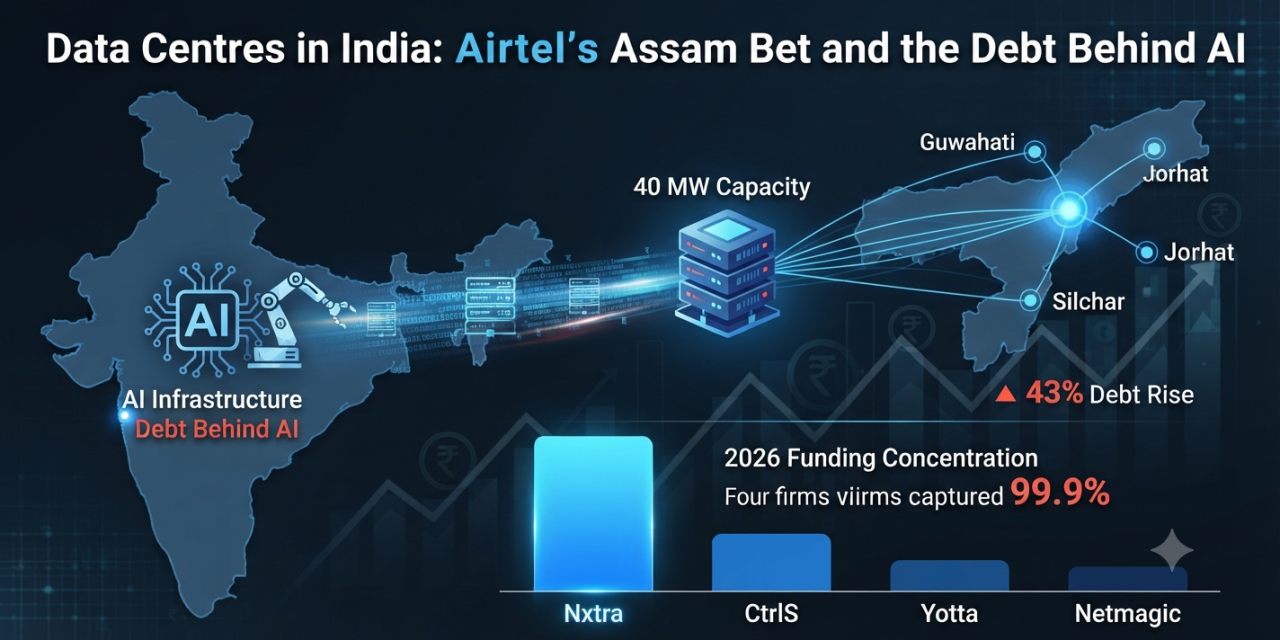
On 25 November, Airtel signed an MoU with the Assam government for three data centres in Guwahati, Jorhat and Silchar. Together they will offer 40 MW of capacity, and land is already in place for all three sites.
- Guwahati: 15 MW, coming up at the IT Park in Bongora
- Jorhat: 10 MW, with a first-phase investment of ₹200 crore
- Silchar: 15 MW, with a first-phase investment of ₹255 crore
Rajan Bharti Mittal, vice-chairman of Bharti Enterprises, said the centres could be ready by 2028. The Jorhat and Silchar sites alone are expected to create about 164 direct jobs. The move fits Airtel’s larger plan for its data centre arm, Nxtra, to grow from about 300 MW today to more than 1 GW.
Source: Business Standard
Data Centre Funding Rises 11-Fold, but Four Firms Take Nearly All
According to Tracxn data analysed by ETInfra, Indian data centre companies raised ₹16,458 crore across seven rounds so far in 2026, compared with ₹1,533 crore across nine rounds in 2025. The catch is concentration: four players account for 99.9% of the total. Nxtra alone took 57.6%, largely from its $1 billion round led by Alpha Wave Global and Carlyle earlier this year.
| Company | 2026 funding |
|---|---|
| Nxtra (Airtel) | ₹9,478 crore |
| CtrlS | ₹4,256 crore |
| Yotta | ₹1,428 crore |
| Netmagic Solutions | ₹1,278 crore |
Smaller startups raised just ₹17.84 crore this year, led by liquid-cooling firm Refroid Technologies. These are funding commitments, not money already spent on running facilities.
Source: The420 (citing ETInfra and Tracxn)
Debt Climbs 43% as Operators Race for AI Capacity
Equity is only half the story. A Mint analysis found that combined borrowings of six large operators rose 43% to ₹27,062 crore in FY26. Yotta carried about ₹7,509 crore, AdaniConneX ₹6,376 crore, CtrlS ₹3,769 crore and Nxtra ₹2,099 crore. Sify Infinit Spaces was the only one of the six whose debt grew more slowly than its revenue.
The reason is timing. Crisil notes that data centre spending comes 24 to 36 months before the facilities start generating cash, so debt is likely to stay high. Lenders are also tying loan releases to project milestones.
Source: Pivot News (citing Mint), NewsBytes
What New Data Centres in India Mean for Businesses
For enterprises and SaaS companies, new capacity in cities like Guwahati and Silchar could mean lower latency and local hosting options in regions that have relied on faraway hubs. For developers building AI products, more GPU-ready space at home makes it easier to keep data in India.
Consolidation is also likely. KKR, Singtel and Tata Communications are reportedly exploring a sale of STT GDC India, which runs over 600 MW, at a valuation of around $5 billion. For job seekers, the sector’s growth points to demand for roles in power, cooling, network and facilities engineering.
Source: Times of Oman
The Takeaway
The money pouring into data centres in India is real, but it is concentrated in a handful of large players and increasingly funded by debt. Watch two things over the next year: whether new capacity outside the big metros actually goes live on time, and how much of it is leased before it opens. Those answers will decide whether this AI build-out turns into lasting infrastructure or a costly glut. If you are a cloud buyer, ask providers for firm go-live dates before you sign long contracts.
Note: Funding and debt figures are as reported by the cited publications and their underlying data sources. Timelines for announced projects may change.