
As Indian companies across finance, e-commerce, healthcare, and manufacturing increasingly build their strategy around data-driven decision-making, the demand for professionals who can actually build and maintain the pipelines that move and clean that data has grown sharply. Data engineering sits somewhat apart from the more visible data scientist role: rather than building predictive models, a data engineer focuses on the unglamorous but absolutely essential work of getting clean, reliable data into a usable form in the first place. This distinction has become better understood by Indian employers over the last few years, and data engineer has emerged as its own well-defined, well-compensated career track rather than a stepping stone role. For engineers considering this path, here’s what the job actually involves and how to break into it in 2026.
What a Data Engineer Actually Does
A data engineer designs, builds, and maintains the infrastructure and pipelines that collect, clean, transform, and move data from its original source into the databases, warehouses, and analytics tools that other teams actually use. This involves writing and scheduling data pipeline code, most commonly using tools like Apache Airflow, designing schema for data warehouses, and continuously monitoring pipelines for failures or data quality issues that could quietly corrupt downstream reports and models. Unlike a data scientist, whose work centers on analysis and modeling, a data engineer’s success is measured by the reliability, freshness, and accuracy of the data itself, work that mostly stays invisible when done well and becomes immediately obvious the moment it breaks.
Core Technical Skills Needed
Strong SQL skills remain absolutely foundational to this role and tend to matter more day-to-day than any single programming language, since so much of the job involves querying, transforming, and validating data directly. Python has become the dominant language for building pipeline logic, particularly alongside frameworks like Apache Spark for processing data at scale and Apache Airflow for orchestrating and scheduling pipeline jobs. Cloud platform experience, particularly with AWS, Azure, or Google Cloud’s respective data services, has become close to mandatory given how much of India’s data infrastructure has moved to the cloud, and familiarity with modern data warehouse platforms like Snowflake or BigQuery is increasingly expected even at the entry level. A working understanding of data modeling principles and distributed systems concepts rounds out the core technical foundation employers look for.
Certifications and Learning Path
Cloud-specific data certifications carry real weight in India’s hiring market, particularly the AWS Certified Data Engineer, Google Cloud Professional Data Engineer, and Microsoft Certified: Azure Data Engineer Associate credentials, all of which signal a structured, verifiable understanding of the specific tools most Indian companies actually run in production. Beyond formal certifications, building a portfolio of real pipeline projects, even personal ones using public datasets, tends to matter enormously in interviews, since data engineering is fundamentally a hands-on discipline that’s hard to demonstrate through credentials alone. Many successful data engineers in India start in a broader software engineering or business intelligence role and transition in gradually, taking on pipeline-adjacent work before making a full lateral move into a dedicated data engineering position.
Typical Career Path and Salary Expectations
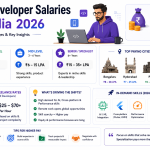
Entry-level data engineer roles in India’s major tech hubs currently see salaries ranging from roughly 6 to 12 lakhs per annum for candidates with strong SQL and Python fundamentals, with mid-level engineers holding three to six years of experience typically commanding 15 to 28 lakhs depending on company size and cloud specialization. Senior and lead data engineers at larger product companies or multinational firms can reach 35 lakhs and well beyond, particularly with deep expertise in a high-demand area like real-time streaming data or large-scale data platform architecture. Freelance and contract data engineering work has also grown steadily as more mid-sized companies look to build out data infrastructure without committing to a full in-house team immediately, giving experienced engineers a viable path to consulting-style work alongside or instead of traditional full-time employment.
For engineers currently working in adjacent roles like software development, business intelligence, or database administration, the most effective path into data engineering tends to combine deliberate hands-on project work with structured cloud certification study, rather than relying purely on formal education. Volunteering to own a data pipeline or reporting infrastructure project at a current job, even a small one, builds exactly the kind of practical experience that separates a strong data engineer candidate from someone who only understands the concepts theoretically. Contributing to open-source data tooling projects or building a public portfolio project using real datasets can also help demonstrate this hands-on capability to employers who may not otherwise see that side of a candidate’s work history during a standard interview process.
Conclusion
Data engineering has become one of the more stable, well-compensated, and genuinely essential roles in India’s growing technology sector, sitting at the foundation of nearly every serious data-driven initiative a company undertakes. For engineers willing to build deep, practical expertise in SQL, cloud data platforms, and pipeline tooling, 2026 remains a strong year to pursue this path, with demand continuing to outpace the current supply of experienced data engineering talent across both product companies and IT services firms in India.