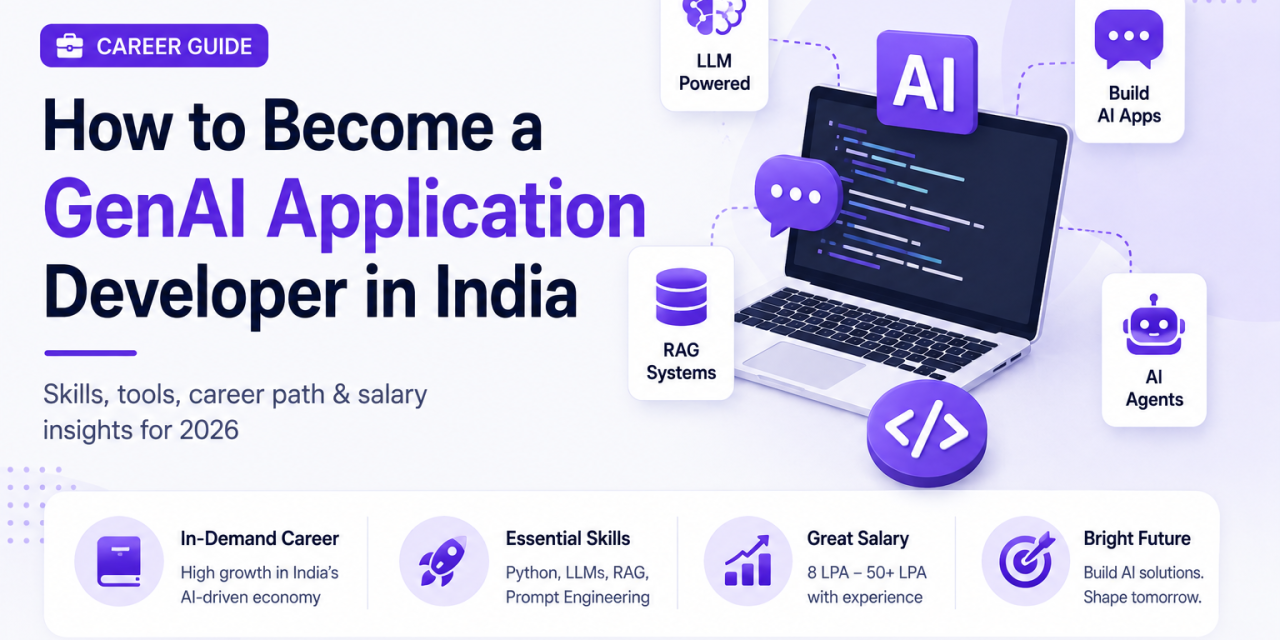
As generative AI has moved from research novelty to genuine product feature across nearly every software category, GenAI application developer has emerged as a distinct and rapidly growing specialization within India’s technology industry, separate from both traditional software engineering and deep machine learning research. The role focuses specifically on building real, production applications around large language models, chatbots, retrieval-augmented generation systems, AI agents, and LLM-powered features, rather than training or fine-tuning the underlying models themselves. This distinction matters because the role rewards strong software engineering fundamentals paired with LLM-specific application patterns far more than deep ML theory. This guide breaks down what the role actually involves and how to build a credible path into it from India’s current tech landscape in 2026.
What a GenAI Application Developer Actually Does
A GenAI application developer builds the software layer that sits between a large language model and an actual product feature, designing prompt strategies, retrieval-augmented generation pipelines that ground model outputs in a company’s own data, and the orchestration logic that lets an AI agent take multi-step actions using external tools and APIs. This work involves considerably more traditional software engineering than pure machine learning, API integration, backend architecture, evaluation and testing frameworks specifically for non-deterministic AI outputs, than it does model training or fine-tuning, which typically remains the domain of a separate machine learning engineering team. Day-to-day work often centers on iterating quickly on prompt design and system architecture while building the evaluation infrastructure needed to catch regressions in an AI feature’s quality before it ships to users.
Core Technical Skills Needed
Strong Python skills remain foundational, particularly fluency with LLM orchestration frameworks like LangChain or LlamaIndex that handle much of the boilerplate around prompt chaining, retrieval, and agent tool use. Deep familiarity with vector databases, such as Pinecone, Weaviate, or pgvector, has become essential for building retrieval-augmented generation systems that ground an LLM’s responses in real, current company data rather than relying purely on the model’s training knowledge. Genuine understanding of prompt engineering as a real discipline, including techniques like few-shot prompting, chain-of-thought reasoning, and structured output formatting, matters considerably, alongside growing expertise in evaluation frameworks that can systematically test whether an AI feature’s outputs remain reliable across a wide range of inputs rather than just looking good in a handful of manual demos.
Certifications and Learning Path
This field remains young enough that formal certifications carry less weight than in more established specializations, and Indian employers in this space consistently emphasize a strong portfolio of real, deployed GenAI projects over credentials alone. That said, foundational certifications from major LLM providers, including OpenAI’s and Anthropic’s own developer documentation and certification-adjacent programs, alongside cloud provider credentials like Google Cloud’s Generative AI certifications, do carry some signaling value, particularly for candidates without a strong existing project portfolio. The single most effective way to break into this specialization tends to be building and deploying a genuinely working GenAI application, even a modest one, a RAG-based internal documentation assistant, an AI agent that automates a real repetitive task, since this field rewards demonstrated shipping ability more than almost any credential could.
Typical Career Path and Salary Expectations
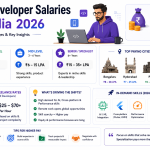
Entry-level GenAI application developer roles in India’s major tech hubs currently see salaries ranging from roughly 8 to 16 lakhs per annum for candidates with strong fundamentals and a credible project portfolio, with mid-level developers holding two to five years of relevant experience typically commanding 20 to 38 lakhs depending on company size and how central AI is to the core product. Senior GenAI developers and technical leads at larger product companies or AI-focused startups can reach 50 lakhs and well beyond, particularly with proven experience shipping production AI agent systems or retrieval-augmented generation pipelines at meaningful scale. Demand for this specialization has grown extremely quickly across nearly every sector of India’s tech industry, since companies of every size are racing to add genuine AI capability to their existing products rather than treating it as an experimental side project.
For engineers currently working in general software development who want to transition into GenAI application development, the most effective path tends to combine deliberate, hands-on project building with genuine production-mindset thinking, treating AI feature reliability and evaluation as seriously as any other critical software component rather than as a novelty demo. Volunteering to add even a small, genuinely useful AI feature to a current product, an internal documentation search assistant, a customer support triage agent, builds exactly the kind of practical, production-context experience that separates a credible GenAI developer candidate from someone who has only experimented with a chatbot API in isolation. Contributing to open-source LLM orchestration tooling or publishing a well-documented personal project with a real, working deployment can also meaningfully strengthen a candidate’s portfolio in a field where demonstrated shipping ability matters more than almost any other signal.
Conclusion
GenAI application development has become one of the most in-demand and rapidly evolving specializations in India’s technology sector, sitting at the center of how nearly every software company is racing to integrate genuine AI capability into its existing products. For engineers willing to build genuine depth in LLM orchestration, retrieval-augmented generation, and production-grade evaluation practices, 2026 remains an exceptional year to pursue this path, with demand continuing to significantly outpace the current supply of experienced GenAI application talent across India’s technology ecosystem.